Friday, June 4, 2010

Why Can’t I Be Spider-Man?


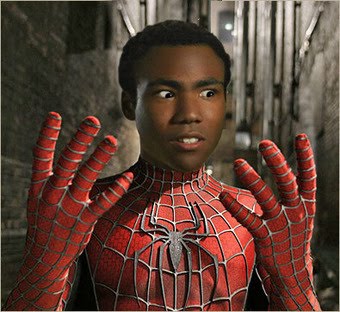
Peter Parker is black. His experience—that of an orphaned teen from Queens who moves in with his lower-middle-class Aunt and Uncle, loses his Uncle to random violence and struggles with money/employment/love after gaining new responsibilities—is uniquely, if sadly–the violence, the substitute parenting, the poor economic condition—African-American. Despite aspects Parker’s of experience that may mark it as distinctly African-American, it is still an experience that is indicative of the American middle-class—albeit lower middle—experience; an experience that, last I checked, is unattached to any one race. Which is why the current debate over a black man’s, actor-comedian Donald Glover, ability to play the iconic Spider-Man strikes me as progressive and sad.

Over the Memorial Day weekend, Glover, Troy on NBC’s Community, started a online campaign to audition for the currently vacant role of Peter Parker/Spider-Man in a Sony’s Spider-Man reboot. Glover’s campaign was a direct response to a rant on sci-fi pop culture blog io9 that stated, “the last thing Spider-Man should be is another white guy.” This statement, both timely and provocative, has met with applaud and derision. The majority of the applaud came from fans who see Spider-Man as a character beyond color: an everyman who speaks to the struggle of growing up and facing responsibility; while detractors take the stance that Spider-Man was designed as white character and should remain thus to ensure a faithful adaptation.


The fact that io9 even raised this question makes my heart glad. As a young comics reader, I always favored Spidey because there was no cowl or spit curl stopping me from thinking he could be black. Sure, I knew Peter Parker was white, but I also indulged the fantasy that a brother could easily be behind the bug eyes. Reading speculation of an African-American Spidey is simply cool. I’m so pleased to see that the world has grown tolerant enough to hear and debate this notion. However, I’m not naïve enough to believe this will be a reality, even in a world where Spidey makes deals with the devil and the first Captain America was black.


Neither Sony nor Disney nor Marvel would risk significantly altering their most bankable property, even if the best man for the job was black, brown or yellow. Donald Glover will not win this role because he is ill suited for the role in any logical way, but because he is not bankable to a mainstream audience. The next Spider-Man movie will not be anchored by a black lead for fear, however illogical, of it being viewed as a “urban” film. The realities of the film industry—of which there is one undeniable truth: what sells, rules—revolve around selling art as a product. If an African-American Peter Parker won’t sell to most audiences then the studios won’t entertain the notion. But, I don’t believe modern audiences would shun a Spider-Man of a different skin color. At least I hope they wouldn’t.


There are myriad reasons why audiences wouldn’t deny an African-American Peter Parker, especially in Glover’s case. Beyond the lively quality a lithe comedian like Glover might bring to the part—including the return of the sorely missed wisecracking—an African-American Spider-Man/Peter Parker will see a subtle ratcheting of the pathos due to the inherent social conditions facing lower-middle class African-Americans, adding even more gravitas to Parker's plight, and a lead that reflects the diversity of 21st century America, particularly that of contemporary New York, the "crossroads of the world." Most importantly, this refreshing take on Peter Parker/Spider-Man has the potential to transcend typical portrayals of African-Americans and their experience. In the past twenty years, how often have audiences seen a male African-American character who isn’t a criminal or a ne’er do well outside of a John Singleton, Spike Lee or Will Smith, Martin Lawrence or Tyler Perry movie? An African-American Spider-Man could prove that our men—those who aren’t Will Smith—could be heroes again. Audiences who voted for the first African-American President would be hard pressed to turn away from a movie that shows African-Americans in a better light. In an age where our images are tarnished by poverty, indignity and thuggish buffoonery, an African-American Spider-Man may not move mountains but it will surely knock a ton of rocks out of place.


Sadly, this may never come to pass, and, if it does, it will be a long ways down the road. But, more unlikely things have happened (looking at you Mr. Obama). And if the unlikely were to occur, it would be fraught with an ungodly level of resistance—racist, traditionalist and irrational—as evident in a fair amount of the early reactions to Glover’s campaign (a fact our President knows about first-hand). Much as I’d love to see an African-American Peter Parker/Spidey, I’ve resigned myself to knowing I will likely never see it happen. But, I also thought I’d never see an African-American president. So, I ask: In a world where it’s viable for one African-American to be elected president, why can’t one be Spider-Man?

Wednesday, June 2, 2010

Splice - Review


** out of five stars

Rule 34 states, “if it exists, there’s porn of it.” After catching a preview screening of writer-director Vincenzo Natali’s new sci-fi/horror thriller Splice, I’m positive that a new type of niche internet porn will arise: gene-spliced human-mutant tongue/human porn. Then again, that may already exist.


My girlfriend called it disturbing; I just thought it was silly and pretentious. Splice is the “cautionary tale” of gene-splicing biologists, Clive (Adrien Brody) and Elsa (Sarah Polley), who, in their quest to create a cure-all protein for a “evil” pharmaceutical company, create a mutant spliced from animal and human DNA. Of course, their project goes south when their mad scientist tendencies flare and they choose to raise the mutant, named Dren (Delphine Chanéac)—nerd backwards, how cute—as a pet/child. Complications ensue when Dren, who grows at an accelerated rate, matures to roughly age 16 in a matter of weeks and faces a sexual awakening that will make audiences cringe or chuckle. Splice culminates with a disturbingly gruesome and silly denouement that ranks as one of the most ludicrous “now, I’ve seen it all” moments ever.


Splice lives or dies by the audience’s willingness to buy into its premise because beyond that there’s nothing spectacular or clever about this flick. The plot is a stale rehash of the age-old “scientist push boundaries and pay for it” construct, dashed with a bit of moral hand-wringing over the ethical concerns of cloning and “animal” testing. The pacing is atrocious. 90% of Splice is setup, with only the last half-hour registering any active development of character or plot. At least an 75 minutes of the film consists of Brody and Polley’s characters bickering over the “morality” of their experiment then struggling with their twisted parenthood, which would be acceptable if the characters were relatable or intelligent. Where Brody’s Clive is a optimistic, if weak-willed, hipster scientist, Polley’s Elsa is a particularly unlikeable mix of a damaged abuse survivor and smug mad scientist. Despite their advanced education, both lack any semblance of common sense when it comes to raising a human/animal mutant hybrid pet/child like Dren. Dren her/itself becomes a more defined character near the films conclusion, but—due to a lack of language, weird spasms and creepy glares—mostly comes off as more of a creepy, horny pet than anything resembling a human.


Despite the issues with plot, pacing and character, atmosphere in Splice is top notch. The camera filter gives the film a blue-green tint that makes the audience feel like they’re submerged in a deep-sea sensory deprivation tank. Also, the limited cast and empty locales, such as the lab and Elsa’s farm, contribute to a foreboding sense of isolation that enhances the notion of hidden shame running through Splice. In addition to atmosphere, easily the film’s greatest achievement was Dren. As a mix of animal human DNA that is 75% human, 5% rat, 5% scorpion, 5% fish, 5% bat/bird and 5% gargoyle, Dren is suitably creepy and oddly alluring. Dren is designed as a sexy manticore, with enough humanity—of course, in the supple female form a la Species—to somehow seduce but lacking enough to make even the most open mind think twice. If Natali’s goal was to achieve the balance between seductive and unnerving, he succeeded ably with Dren.


If Dren and her “parents” exploits prove less then disturbing then this may be the flick for you. Otherwise, it is an acquired taste that most audiences won’t want to sample. Splice may have a wonderfully speculative, if creepy, moral conundrum at heart, but its stale plot, turgid pacing and distasteful characters will keep audiences at a distance. While it succeeds on atmosphere and “creature” effects, Splice tries to hard to ask questions that have been asked before while trying to creep its audience out. It succeeds more in the latter than the former, because I felt pretty slimy after leaving the theater.

Wednesday, May 12, 2010

Kicking The Iron Man's Ass - Humanity in Kick-Ass and Iron Man 2


Half an hour into Iron Man 2, I checked my cell phone clock, slouched in my seat, and leaned on the arm rest. Iron Man 2 blew into theaters last Friday, with the requisite mixed critical reaction and fanboy fervor, and it was easily the most tedious superhero flick I’ve seen in a while.

I’ll admit I never cared for Iron Man/Tony Stark and his “struggles” as the smartest, richest man in the Marvel-verse—in fact, I actively despised the clown after he inadvertently precipitated Captain America’s “death” —and cared little for the corporate intrigue of the first film. Yet, I enjoyed Robert Downey Jr.’s performance as Tony Stark, mostly because of the sheer force of his personality. Once I saw the commercials for the sequel, I expected more of the same: a great performance by Downey and a middling story of corporate espionage peppered with mecha battles. I was right. Iron Man 2 dropped below my expectations with pitiful pacing, dues ex machine plot and action figures for characters. Tony Stark, Natasha Romanov (Black Widow), Ivan Vanko (“Whiplash”) and Justin Hammer weren’t real characters; they were toys.

A week before Iron Man 2 was released, I had the pleasure of catching a film that actually treated comic book characters like human beings: Kick Ass. Kick Ass, distributed in comic form by Marvel’s creator-owned imprint, Icon, was a fun, memorable flick that put people before and “super” heroes. In Kick Ass, the story of normal people who pursue super heroics in the “real” world, each character had a life before heroism, or vigilantism as the case maybe. Whether it was Dave Liezewski’s (Kick Ass) mundane existence as a teenage nobody or Mindy McCready’s (Hit Girl) all-to-brief childhood, I believed these characters had a life—one I could relate to--beyond their absurd exploits. These characters also had clear goals. Big Daddy’s quest for revenge and Dave Liezewski’s grab at gallantry may be obsessive and misguided, but at least they were more realistic than Tony Stark being stingy with his super armor. Admittedly, both flicks strain plausibility, but the characters of Kick Ass ground the film in a semblance of reality that encourages the audience to care and cheer for the characters despite their suicidal stupidity. In Iron Man 2(IM2), the audience is told to love the super kewl characters because of their hipper-than-thou dialogue and feats of computer generated derring-do.

A comparison the of Kick Ass and IM2’s characters shows just how crucial grounded, relatable characters are to the effectiveness of films that demand suspension of disbelief. Kick Ass protagonist Dave Liezewski becomes "super" hero Kick Ass for reasons both selfish and altruistic. As much as Dave’s interest in being a superhero is bolstered by his desire for girls and popularity, he also genuinely wants to protect people, even at risk to his own safety. Tony Stark became an amplified version of this character type in the first Iron Man, as he gradually evolved form an arrogant hot shot to a hero who wanted to protect the world and erase his sins. But, in IM2, Stark regressed to the being a petulant prick due to an inability to cope with internal and external challenges. All of Stark’s character growth in IM1 is nullified by his actions in IM2. Stark is more interested in protecting his precious suit from antagonists that may never exist in the really real world than protecting the helpless from real-life terrorists. Conversely, by the end of Kick Ass, Dave Liezewski has moved from being teen with a power fantasy to honest-to-God hero when he helps Hit-Girl get her revenge on the D’Amico mob. Adding to Dave’s human-centered heroism is his resolve after being brutally injured. He doesn’t magically invent an element to save his life; he lies in the hospital, heals and returns to crime-fighting once he’s healthy. Kick Ass’ return to the streets may be based on delusional obsession, but positively rebounding from injury after a long recuperation is all-too-human.

Kick Ass’ humanity is echoed in the exploits of Big Daddy and Hit Girl. Big Daddy and Hit Girl are the opposite of IM2’s Ivan Vanko and Natasha Romanov. Big Daddy, like Vanko, is man trying violently and decisively avenge himself and his family. Both characters want to make powerful men suffer, but where their stories differ is the quality of the motivating offense and their physical response. Ivan Vanko builds a exoskeleton with electric whips to show the world “he can do what Stark can do better.” Big Daddy builds his body and gun collection while turning his daughter into a weapon in an effort to kill the man who sent him to prison and “killed” his wife. While both responses are ridiculously disproportionate, Big Daddy doesn’t care about embarrassing his opponent; he wants the guy dead. Vanko wants to shame Stark, with Stark’s death being a bonus. Both characters build “arsenals,” but Big Daddy treats himself and his daughter as the ultimate weapons as opposed to Vanko’s Gundams. Vanko balances equations and tinkers with toy robots before fighting Iron Man in a suit, that will surely protect him from nuclear attack. With little more than a bullet proof vest and some sturdy leather, Big Daddy and sidekick/daughter Hit Girl put their own bodies on the line to attack their enemies, a fact particularly evident in any scene featuring Hit Girl.

Compared to Natasha Romanov, her closest analogue in IM2, Hit Girl is a paragon of human heroism. Trained in the “art of death” by her father, Hit Girl is efficient and ruthless, yet charming and exuberant. She may move, bouncing around like a ninja slash the bad guys—in a far more effective and less-showy manner than the hipper-than-thou Romanov—but, on her off-hours, she’s a kid who loves her Dad and her toys. Hit Girl’s father may be certifiable and her toys—guns, knives and jetpacks—are surely dangerous, but its her genuine glee and warmth that reminds the audience—especially when she’s being beaten by a man three time her size—that this a “real” 11-year old child. Natasha Romanov, on the other hand, is a fembot. There’s no humanity behind her eyes, no life to her story. She’s a fully-poseable cheesecake maquette doing tricks that pale in comparison to Hit Girl’s more efficient, practical carnage. In IM2, Natasha is given one clumsy scene to demonstrate her “skill” and make the audience like her. In Kick Ass, the audience falls in love with Hit Girl because see her story and watch her drop every thug in a room more than once.

Rounding out the main characters of both films are antagonists that toe the line between friend and foe. Kick Ass’ Chris D’Amico (Red Mist) and IM2’s Justin Hammer both enter their respective films as ineffective jokes. Through betrayal and subterfuge, , they morph into dangerous villains as the films progress. The difference between these two villains is the nature of their threats, particularly in relation to the loss of human life. While Hammer is satisfied with stealing government contracts and Iron Man suit from stark, Chris takes part in a betrayal that truly threatens the lives of Kick Ass, Hit Girl and Big Daddy. By putting human life in the crossfire, rather than contracts and magic suits of armor, Kick Ass demonstrates that it deals in absolute, far from the vagaries of IM2. The villain’s response to the unveiling and, subsequent, foiling of their schemes highlights this principle. Chris is shocked, hurt and betrayed when his father threatens the heroes, and, later, is so angered by the death of his father that he sets forth on a path towards bloody vengeance. Justin Hammer, on the other hand smirks when he gets caught for allowing Vanko to turn his military robots into Iron Man-hunters. He even quietly went to jail rather than disappearing. Judging by the endings of both films, one could anticipate that in future sequels Justin hammer will return to take Tony Stark’s company while the Red Mist will return to take Kick Ass’ life. Those assumptions are indicative of the fundamental divergence between these two films: the weight of the human element.

The human element--prevalent in Kick Ass, yet lacking in IM2--grounds the fantastic in reasonable reality, encourages audience investment through character development and raises the stakes by putting lives, not companies or magic armor, in danger. The more attention a film pays to character the less likely it is to require contrived stakes. IM2 deals solely in contrived, inhuman stakes. None of the characters are ever in any real danger, so nothing matters, save plot progression. And, that’s what Marvel cares about: the mighty march to the Avengers epic. The characters in IM2 don’t serve an engaging story that delves into their core and examines the motivation and consequence of their actions; they serve a plot that teases the Avengers. Until Marvel executes its event film, and puts character first, creator-owned comic book movies will—much like their printed counterparts—capture audiences by telling stories about characters worth caring for.

Wednesday, April 28, 2010

Empty After the Ending

I’m getting old. I’m convinced my taste in movies has matured to the point where very little surprises or impresses me. The summer movie season will kick off in a week with Iron Man 2, and I’m not nearly as excited as I was ten, or even five, summers ago. How can I be? Look what’s coming in the next few months: two more additions to the increasingly exhaustive line of superhero flicks, Iron Man 2 and Jonah Hex; the Pirates trilogy meets video games experiment, Prince of Persia; more installments of adolescent literary fantasies, Twilight: Eclipse and Harry Potter and Deathly Hallows Part 1; two more spins on the A-Team formula after this Spring’s The Losers, A-Team, ironically, and The Expendables; and a female twist on the Bourne Identity, Salt. While a few original ideas sneak between the derivative—Last Airbender and Inception—most of this summer’s blockbuster’s look to be trite, forgettable affairs.

Lately, the blockbusters bombarding multiplexes every Friday and breaking billion dollar records aren’t making the impression they used to. I remember breaking my neck to get to the movies every Friday in late 90s and early 2000s. Those days gave audiences some great movies, didn’t they? I still quote Maximus’ rousing, vitriolic speeches while remembering his unrelenting climb from slavery to glory to freedom. I easily recall the valor of the Fellowship of the Ring at Helm’s Deep and on Pelennor Fields. I apply Alonzo Harris’ philosophies on a daily basis. I still marvel at Spidey’s first swings through the glass and steel caverns of Manhattan. I smile when thinking of the lethal beatings delivered by Jason Bourne, James Bond and Bruce Wayne. I can’t say that many of the blockbusters from the past two years have delivered the same quality of memories, and I doubt this year’s crop will prove different. At this point, I could almost care less about catching this year’s blockbusters. Almost.

Catching the next big tent pole release, week after week, is just a chore these days. I can only feign so much enthusiasm for the next “blockbuster” that attempts to top the spectacle and box office of the previous week’s top earner—albeit with a fraction of the humor, heart and character of flicks from the early days of the last decade. Spectacle is all audiences get today, and I’m tired of it. Honestly, how many ‘kewl,’ over-the-top, CGI spectacles can the industry pump out before even the lowest common denominator is no longer impressed? The studios may believe that the average moviegoer will never go unimpressed, but I would bet the domestic take of this year’s highest grossing film that even the most easily satisfied moviegoers will eventually crave something with at least a sliver of depth, something that they dare to remember after they leave the theater.

With the success of the forgettable, derivative visual vomit that was Avatar, spectacle has reached a profitable apex, and studios will likely be less inclined to finance films with a modicum of depth. Avatar proved, nearly single handedly, that millions of viewers care less about characters and story and more about hi-def visuals, 3D landscapes and explosions that pretend to singe their eyebrows. Over a billion served may not care, but I do.

I’ll admit to being curious enough about some of today’s spectacle-laden blockbusters to check them out on opening weekend. Even I can’t deny that going to movies is a, relatively, inexpensive weekend diversion—and heck, I still love movies despite their increasing lack of depth. But, by the time most movies are over, I just don’t care. After some light introspection, I know why. I’m tired of spectacle after spectacle. I’m sick of movies being nothing more than a collection ‘kewl’ moments. I’m over limp stories that make you yawn in between those moments. I’ve had enough of the moviegoing experience overshadowing good storytelling. Tell me a good story with cool characters and slick, clever action and I’ll be happy. Sadly, I doubt any of today’s studio-supported filmmakers will oblige me.

I can name a dozen “holy shit” moments from the top earners of the past two or three years, but I can barely recite a plot or name a character that I honestly cared about beyond the post credits sting. Sure, I remember Captain Jack and Robert Downey Jr.—who, by playing himself in his past two mega-hits, is more a draw than the characters he’s playing—as well as the cool stories of a Nazi-hunting brigade of Jewish soldiers, post-9/11 Batman and bomb dismantling specialists in Iraq, but those are exceptions. Allow me to point to any film starring Sam Worthington as examples of the rule. With a blank slate lead and a clichéd "band of heroes save the world, civilization, (insert motivation here)" plot, flicks like Terminator: Salvation, Clash of Titans and Avatar are becoming a template for box-office gold (Okay, maybe not those first two, but definitely the third). Not to mention, the rapid expansion of Marvel and, to a lesser extent, DC’s comic universes, whose superhero sagas are becoming so prevalent that two summers ago (2008’s geekgasm) it seemed like the only movies in theaters were based on comics.

I love comics, particularly the art and the format. But, even as a comics-obsessed teen, I could never get invested in the popular superhero stories. Every story was just a slight variation on the same formula. The thing about formulas is they produce consistent results with very little derivation. No comic fan or cinephile can tell me, with a straight face, there’s more than a fraction of difference between Batman and Iron Man. And, how many comic flicks are just different versions of adolescent power fantasies writ large with colorful characters that would be promptly injured, quickly ridiculed, thoroughly subjected to psychiatric evaluation in real-life(thanks, Kick Ass and Watchmen). I don’t mind suspending disbelief and taking flights of fancy, but all the flights are going to a place I’ve been before. However, as long as there’s gold in them hills, then Hollywood will follow. I’m just not sure I want to follow them anymore.

I love original—or at least as original as is possible in today’s over-saturated media—stories. I cherish cool characters. But, the more I watch, the more everything seems the same. When I leave the theaters today, I’m friggin' crestfallen. You expect a great experience and all you get is a two-hour 3D ride. There's no memorable character or moving scene to recall, just the empty feeling of stepping off the roller coaster so the next person can take their turn. I’ll ask my moviegoing companions what they thought then they’ll ask me, and we all respond by shrugging our shoulders and saying, “Meh. It was okay.” By the way, thank you for ‘meh,’ Lisa Simpson. No other word so simply encompasses the utter apathy I feel for most of today’s filmed entertainment. It’s a sad day when the best response you can muster to a film is ‘meh.’ In a way, the ‘meh’ response reminds me of ‘pops,’ or audience reaction, in pro wrestling. Wrestlers say that they can appreciate being cheered and jeered, but an apathetic, disinterested crowd response is worse than death. Maybe, it’s not the fault of the studios, or the filmmakers, or the actors, or the source material. Maybe, I don’t care because I’ve seen too much. Maybe, I’m wrong for valuing story and character over spectacle. Or, maybe, other mediums are telling better stories, stories dashed with spectacle and replete with compelling characters and engaging plots. Maybe, television, video games, and, to some extent, the internet really are to blame.

I’ll jump on the bandwagon with the studios and agree that TV, video games and the internet are drawing attention away from movies. The rise in popularity of the serial drama on television has led to sprawling engaging series with deep, complex characters and refreshing plots that encourage viewer investment. Today’s television series want viewers to come back each week and see how a grand story ends, which is, more often than not, infinitely more satisfying than the denouements of most “blockbusters.” Much like modern TV series, Video games also offer deep, stirring narratives that thrive on an investment derived from their innate interactive nature. In top-selling games like Grand Theft Auto, Halo, Gears of War, Metal Gear Solid, Arkham Asylum, etc, I am the protagonist. I am an active participant in these worlds rather than a passive witness. It doesn’t hurt that you can enjoy both in hi-definition for a cost that, in the long run, is a lot cheaper than a weekly trip to the movies. As far as the other accomplice, the internet, I can find more pure comedy in a 30-second YouTube clip than most big screen comedies. I can watch most of the TV shows I love while downloading episodic content for my favorite video game with one device.

I’ll never stop loving movies. As long as daring filmmakers and smaller studios keep telling great stories in lieu of barn-burning special effects rides, I’m there. I’ll even continue to check out those big blockbusters because I’m curious and I have to do something my Friday nights. But, until the principles that guide those smaller films truly impact the way tent poles and megahits are crated, I doubt I’ll remember anything about this decade’s “blockbusters” besides a few “kewl” moments.
I'm Back

After an extra long hiatus, the Storyteller's Journal is back with a new purpose and perspective. Te all-new and all-different, as it were, Storyteller's Journal will focus on approaching film, TV and pop culture media from a unique perspective. I will be posting more editorials and features about the storytelling themes and trends, along with some personal observations on pop culture media. I'm going to do my best to keep up with the posts and provide some cool stuff along the way while the pretentiousness to a minimum. Enjoy.