I returned from my first pilgrimage to Comic-Con inspired, but broken-hearted.
Comic-con was every inch the spectacle of legend. The central exhibition hall of the San Diego Convention Center, a two-block long cage of white-washed steel and glass, was crowded from wall to pillar to post to wall with an ocean of ‘geeks,’ children, tourists, stars, creators and drag-a-longs. The crowds clamored, pushed and tugged beneath towering displays of supersized mechas and movie posters, grabbing and snatching at every free trinket or toy tossed in their general direction. The hallways above the exhibition hall were congested with snaking lines that wrapped around, inside and outside the convention center. Hall H alone was a staggering, humbling sight. The cavernous hall, housing more seats than a small theater, barely contained crowds of thousands who waited hours with baited breath, and sharpened pencils, to squint at the movie stars of the month and gaze at sizzle reels. Among those crowds, the brown and, especially, the black faces were easily outnumbered by what seemed to be a 100 to 1 ratio.
For two days, my girlfriend and I squeezed through the stifling crowds, sliding between bodies to grab swag and wearing out the soles of our feet for a chance to see our favorite TV stars from 300 yards away. As we shimmied through the crowds and stood in ridiculously long lines, I noticed how rare a sight we were. In a moment like this, my girlfriend’s brother would pose the terribly clichéd inquiry, “How does it feel to be the pepper in the salt shaker?” My typical response would be to let the question hang until the silence becomes too awkward to continue any conversation. But this time, I would’ve answered, “lonely and discouraging.” Sure, attendees of myriad ethnicities attended Comic-Con. The diversity of California’s population practically demands it. But, among the rainbow of attendees, people of African descent were notoriously underrepresented. As bad as it seemed, the dearth of black creators and talent was even more distressing.
The minimal presence of black artists at Comic-Con was enough to make one ask, “Do we have any imagination?” Personally, I wondered: Where were the representatives of Aaron McGruder’s Boondocks—a series steeped in as equal doses of pop culture lexicon to rival Scott Pilgrim—? Who was present to discuss DC Comics Milestone Line—one of the most influential collection of African-American superhero creations—? I know we are capable of contemplating and conjuring the same feats imagination as creators of any other culture—despite having less money in many cases—but looking across the exhibit hall would prove that assertion wrong. I passed maybe four or five booths, out of hundreds, with black artists and, even more depressing, maybe one or two booths with black-owned properties. Of the two booths displaying black-owned properties I saw, one was a cheaply-made comic with poorly rendered superhero archetypes and the other was a clear Boondocks knock off, complete with brown-skinned anime characters. Generally, this type of creativity is inoffensive and tolerable, but, in a room where creativity is bursting at the seems, a couple of derivative projects with brown and black characters weren’t going to draw much attention. Perhaps the best example of dismal black attendance on either side of the Comic-Con fence came in the last minutes of our last day at the convention. My girlfriend and I were making our final rounds on the exhibit floor, minutes before the doors were to close, when a stocky black man with a immaculate ‘fro and a wide collared shirt over a canary yellow suit caught sight of us. I saw him approaching out the corner of my eye, hoping he wasn’t some suit trying to drag us to a preview of some hackneyed project like No Ordinary Family or The Cape. Instead, he politely blocked our path and asked “Do you guys know Jim Kelly?” Of course, I knew the legendary Jim Kelly from Enter the Dragon and Three the Hard Way. Since the question was obviously directed at me more than my girlfriend, I replied with a guarded enthusiasm, “Yeah.” He responded, “He’ll be here tomorrow…Come and check him out.” We nodded, feigning enthusiasm and knowing that, even if we were coming the next day, we probably wouldn’t stop to see Mr. Kelly because we’d rather catch the Marvel movie preview in Hall H.
Our apathy for black projects or seeing an aging black actor was likely informed, in some part, to the apathy our people show towards aspects of pop culture that don’t include music or sports. Despite the fact that the world is falling at the feet of the comic and video game gods, we don’t seem to care to contribute. However, we’ll gladly consume. We’ll buy movie tickets, video games, toys and a select few will purchase comics, but we rarely have a presence at the creator’s table and, at times, it seems that we don’t care to. Now, I won’t decry the hard work of the black creators who are stretching their imagination and creating uniquely creative work that demonstrates we are on par with the best creators of any color. Unfortunately, these creators are buried beneath the rappers, athletes, actors and quasi-celebrities who most of America associates with black “creativity.” Making matters worse is the reluctance of some creators, even the best, to avoid creating material so ingrained in “our” struggle that it turns off the mainstream consumer. I believe everyone should tell their story their way, but if we persist in telling stories with decaying neighborhoods, discordant romances and preachy drag queens, and we only stretch our imagination to evaluate the same issues of racism, poverty, and urban despair that have been repeated ad-hoc for decades then we risk alienating mainstream audiences who are far more engaged in the fantastic than the tragicomic. We don’t have to sacrifice the spirit of our stories and the integrity of our voices, but a little variety wouldn’t hurt. There are infinite ways to address these issues with imagination and ingenuity, from metaphor to allusion. If we, as creators, don’t embrace creative approaches to our material and start dreaming a little bigger then we’ll be stuck selling the same stories to the same people. With African-Americans making up a small percentage of the country, how far will that strategy take us?
To be fair, I’m sure a number of black creators and talent would have willingly attended Comic-Con to sell their stories and promote their projects. I’m also sure that there’s a sizable community of African-Americans and individuals of African ancestry from other countries who would love to have attended the convention as witnesses to the glut of creativity, but couldn’t for a myriad of circumstances. The truth is not everyone’s going to make the pilgrimage every year, but that shouldn’t stop those of us who love this stuff—the comics, the movies, the video games, the genre shows, the anime, etc.—from trying, at least once. And, for those of us who dare to create pop culture art or tell a wildly inventive story—myself included—it is imperative that we make the pilgrimage at some point, so that we can share our creations with an audience that will devour them without hesitation. Let’s just be sure to bring something fresh and original that will blow the geeks out of the water and show them that creators of color can dream as big and as bright as the best in the business.
Showing posts with label African-American. Show all posts
Showing posts with label African-American. Show all posts
Tuesday, August 24, 2010

Friday, June 4, 2010
Why Can’t I Be Spider-Man?
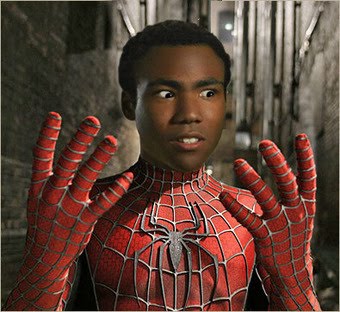
Peter Parker is black. His experience—that of an orphaned teen from Queens who moves in with his lower-middle-class Aunt and Uncle, loses his Uncle to random violence and struggles with money/employment/love after gaining new responsibilities—is uniquely, if sadly–the violence, the substitute parenting, the poor economic condition—African-American. Despite aspects Parker’s of experience that may mark it as distinctly African-American, it is still an experience that is indicative of the American middle-class—albeit lower middle—experience; an experience that, last I checked, is unattached to any one race. Which is why the current debate over a black man’s, actor-comedian Donald Glover, ability to play the iconic Spider-Man strikes me as progressive and sad.
Over the Memorial Day weekend, Glover,
The fact that io9 even raised this question makes my heart glad. As a young comics reader, I always favored Spidey because there was no cowl or spit curl stopping me from thinking he could be black. Sure, I knew Peter Parker was white, but I also indulged the fantasy that a brother could easily be behind the bug eyes. Reading speculation of an African-American Spidey is simply cool. I’m so pleased to see that the world has grown tolerant enough to hear and debate this notion. However, I’m not naïve enough to believe this will be a reality, even in a world where Spidey makes deals with the devil and the first Captain
Neither Sony nor Disney nor Marvel would risk significantly altering their most bankable property, even if the best man for the job was black, brown or yellow. Donald Glover will not win this role because he is ill suited for the role in any logical way, but because he is not bankable to a mainstream audience. The next Spider-Man movie will not be anchored by a black lead for fear, however illogical, of it being viewed as a “urban” film. The realities of the film industry—of which there is one undeniable truth: what sells, rules—revolve around selling art as a product. If an African-American Peter Parker won’t sell to most audiences then the studios won’t entertain the notion. But, I don’t believe modern audiences would shun a Spider-Man of a different skin color. At least I hope they wouldn’t.
There are myriad reasons why audiences wouldn’t deny an African-American Peter Parker, especially in Glover’s case. Beyond the lively quality a lithe comedian like Glover might bring to the part—including the return of the sorely missed wisecracking—an African-American Spider-Man/Peter Parker will see a subtle ratcheting of the pathos due to the inherent social conditions facing lower-middle class African-Americans, adding even more gravitas to Parker's plight, and a lead that reflects the diversity of 21st century America, particularly that of contemporary New York, the "crossroads of the world." Most importantly, this refreshing take on Peter Parker/Spider-Man has the potential to transcend typical portrayals of African-Americans and their experience. In the past twenty years, how often have audiences seen a male African-American character who isn’t a criminal or a ne’er do well outside of a John Singleton, Spike Lee or Will Smith, Martin Lawrence or Tyler Perry movie? An African-American Spider-Man could prove that our men—those who aren’t Will Smith—could be heroes again. Audiences who voted for the first African-American President would be hard pressed to turn away from a movie that shows African-Americans in a better light. In an age where our images are tarnished by poverty, indignity and thuggish buffoonery, an African-American Spider-Man may not move mountains but it will surely knock a ton of rocks out of place.
Sadly, this may never come to pass, and, if it does, it will be a long ways down the road. But, more unlikely things have happened (looking at you Mr. Obama). And if the unlikely were to occur, it would be fraught with an ungodly level of resistance—racist, traditionalist and irrational—as evident in a fair amount of the early reactions to Glover’s campaign (a fact our President knows about first-hand). Much as I’d love to see an African-American Peter Parker/Spidey, I’ve resigned myself to knowing I will likely never see it happen. But, I also thought I’d never see an African-American president. So, I ask: In a world where it’s viable for one African-American to be elected president, why can’t one be Spider-Man?
Subscribe to:
Posts (Atom)