![]() |
| "No. We don't need spandex. Our shirts are tight enough." |
Storytelling has evolved since the era of the griots. Today, storytellers use a breadth of mediums to tell great stories. As a storyteller and an admirer of the art of storytelling, I created this journal as place to comment on storytelling in the age of new media.
Thursday, May 23, 2013
Our Avengers - Why The Fast and Furious is a Superhero Series for Everybody
Sunday, July 15, 2012
Comic Con Day 3 Report
Today, we stood in three lines, and only one of those lines got us anywhere.
We got to the convention center around 11 and went straight to the back of the line to the consistently crowded Ballroom 20, where we stood in line for three hours to get into the Vampire Diaries panel, which you can see the live blog of here.
After scooting out of the Vampire Diaries panel, we jumped in another line, this one for Marvel's movie panel. Unfortunately, the line didn't move, and ten minutes before the panel started, we escaped and made our way back to the Exhibit Hall to scour for more free stuff.
While trolling for handouts and giveaways, we caught a few pictures of Taraji P. Henson, for those Baby Boy and Tyler Perry fans out there, during a signing for CBS' Person of Interest. Taking pictures of celebs at Comic Con is the equivalent of being a red carpet paparazzi. Teeming crowds converge on a less than 100 square foot booth. Hands raise above heads, dangling cameras at odd angles. Flashes pop as the crowd some random soul screams for a distracted star's attention, and all you can do to get a shot off is slide your hand between a pair of bodies and push the button blind, hoping you caught a picture with the star facing you.
I was lucky. I managed to get a picture with the star actually facing me.
Other highlights of the day:
- The Vampire Diaries panel was great for the fans but ultimately revealed very little about where the fourth season was going.
- Marvel debuted footage of Iron Man 3 and announced the titles of the upcoming Thor and Captain America movies, respectively: Thor: The Dark World and Captain America: Winter Soldier.
- Marvel also announced movies for C-list hero Ant-Man (Spider-Man but not) and cosmic superteam The Guardians of the Galaxy.
- Warner Brothers debuted footage of Zack Snyder's Superman: Man of Steel, Guillermo Del Toro's giant robots vs. giant monsters epic Pacific Rim, and Peter Jackson's Lord of the Rings prequel The Hobbit.
Monday, July 9, 2012
Soider-Man and the Amazing Zeitgeist
Thursday, July 21, 2011
Review - Captain America: The First Avenger

Good: Good old-fashioned superheroics with an earnestness missing from most superhero movies; Anchored by solid, likable performances from Evans, Atwell and Jones; Cool Easter eggs for comic fans
Bad: Some weak CGI and needless special effects; rushed ending
Ugly: When the Red Skull loses his face.
When I was about ten, my favorite superhero movie was not Superman or Batman, but Disney’s adaptation of The Rocketeer. I didn’t recognize the nostalgia for what it was at the time, but I knew Nazis were bad and a guy with jetpack strapped to his back, which was as likely to kill him as propel him into the air, would never be anything but cool. Seeing the movie again earlier this year, I realized how great it really was. It was an earnest piece of nostalgia—almost twenty years later and I get it—that was unafraid to be simple, good old-fashioned superhero fun. Marvel’s Captain America: The First Avenger is the perfect heir to the Rocketeer’s legacy, delivering a plain old fun superhero tale that recalls the virtues of Golden Age comics with little of the angst and pretense of most superhero movies.
Captain America breaks the cycle of rote origin stories to become Marvel’s best movie since the first Iron Man thanks in large part to its likable cast and commitment to unabashed, uncomplicated superheroics. Chris Evans, the former Human Torch, stars as the titular Sentinel of Liberty, Steve Rogers, who begins the movie as a 98 lb. weakling desperate to join the allied effort to battle the Third Reich in 1942. Evans plays Rogers perfectly as a hero with a heart bigger than Spider-Man’s and easily more willpower than Green Lantern. Evans’ Rogers is tough and patriotic, but not overbearing as one might expect from a hero draped in the flag, and this is all before he becomes Cap. After four failed attempts to enlist, Rogers is handpicked by genteel, noble German refuge Dr. Abraham Erskine (Stanley Tucci, playing another sublime variation on the world’s coolest mentor), at the Stark Exposition no less, for an experimental procedure. With the help of austere British agent Peggy Carter (Hayley Atwell) and the father of the future Iron Man, Howard Stark (Dominic Cooper), Erskine subjects Rogers to a super scientific procedure that basically equates to an injection of steroids in an industrial strength tanning booth. Rogers emerges as the picture of human perfection, with peak human agility, speed and strength. Ironically, he’s the embodiment of Hitler’s Aryan ideal sent to sock Hitler in the face.
On the other side of the Atlantic, the result of Erskine’s first experiment, Nazi malcontent with a severe skin condition Johann Schmidt aka The Red Skull (Hugo Weaving), is building an army known as Hydra that will break away from the Third Reich and bring the world to its knees. As the Red Skull plans to take over the world with the help of a cosmic device yanked from Odin’s treasure room—see, it’s all connected—Cap slogs through a stint as a USO mascot and war bonds salesman before single-handedly rescuing a unit that includes his best friend, one James Buchanan “Bucky” Barnes (Sebastian Stan), and setting himself on a crash course with the Skull and Hydra.
While Evans does a great job toning down his typical snarky charisma and imbuing Cap with a respectable, genuine sincerity, he is supported by a more than able cast that includes Tommy Lee Jones and a number of familiar, if not overly famous, faces. Hayley Atwell’s Agent Carter is a solid romantic foil for Cap. She is competent and tough, but shows feelings for Cap without being schmaltzy. Jones plays the Colonel of Cap’s unit with the rugged toughness that has defined Jones career. In Cap, he seems to be rehashing his Agent K persona from Men in Black while seeming to have as much fun in a comic-based film as he’s had in a long time. Sebastian Stan is great in a smart turn as Bucky Barnes. Comic fans will be familiar with Bucky as essentially Captain America’s Robin, a teenage sidekick thrust into a ridiculously dangerous situation. Here, Director Joe Johnston and a screenwriting team led by Christopher Markus make a smart move by aging Bucky to adulthood and establishing a more storied rapport between the two. Dominic Cooper brings a cocky spark to Howard Stark that mimics Robert Downey’s performance as Howard’s son Tony.
Hugo Weaving does a serviceable job as the Red Skull, a villain who is not as flamboyant as the Joker or the Green Goblin. Due to the focus Red Skull as the force behind on Hydra rather than a weapon of the Third Reich, Skull loses a bit of his edge. Weaving doesn’t help by dropping the German accent a few times and wavering between slightly over-the-top villainy and believable menace. On average, the performances in Cap are uniformly great in their balance between cockiness and grit that many, right or wrongly, believe defined the WWII era.
Director Joe Johnston was seen as a questionable when announced, but, as the man who helmed The Rocketeer, he’s actually perfect. With Captain America, he did a great job of recreating the visual feel of 1940s serials, complete with sepia filter and halo effect. It was an especially wise choice on his and Marvel’s part to avoid temptation to bring Cap into the modern age too soon. The war era setting makes the characters earnestness much easier to digest and seems to deflate any cynicism very quickly, mostly due to the rose-colored glasses through which many view WWII. Marvel Zombies will also be pleased with Easter eggs of some notable heroes and villains from the era and nods to classic Cap mythos, including a pretty faithful recreation of the original costume used in serials from the 40s—though, it must be said, the new costume is pretty cool and is probably the most practical superhero costume since Batman’s Dark Knight variation.
Captain America fails a bit with some visual effects that can be a bit hokey with the main offender being the CGI de-muscling of Chris Evans. One thing about Cap that Johnston may have missed is that he’s not superhuman. Cap is the peak of human physical ability, so there’s no need for him to toss guys around like superman. If Johnston and Marvel would have looked to the Bourne trilogy for inspiration, they could have made Cap a living weapon with a minimum of special effects. Captain America also suffers from a rushed ending that removes the possibility of some very necessary character development for Cap. In the Marvel Universe, Cap is known as a master strategist who has logged hundreds of missions. The movie glosses over the mission’s that would have built Cap’s legend in effort to jump forward. Hopefully, there will be a sequel that eschews a modern adventure for a look at the parts of Cap's legacy that Johnston skipped.
I don’t normally call for sequels, but I want to see more Captain America. Not many superhero movies have been this enjoyable, likeable and just plain fun. It may not have the edge that more jaded members of the audience are looking for, but it trades the snark and angst that defines Marvel for a genuineness that is sorely lacking in most superhero films. Many in know will only see this as another of Marvel’s 90-minute commercials for next year’s Avengers, but Cap, just like Steve Rogers, is so much more and that’s worth saluting.
Wednesday, June 15, 2011
The Mainstream Niche - How DC and Marvel Can Expand Their Audience

This is not even a remotely shocking move. DC has officially rebooted its entire line at least once, and that’s not even counting semi-reboots like the recent ‘One Year Later’ and countless restarts for titles with beloved characters and weak sales. The more significant news to come from this announcement—despite the insistence of major media outlets and comic snark forums that are wasting time analyzing the DC pantheon’s new costumes—is DC’s new digital sales strategy, which will see the publisher releasing digital versions of its comics on the same day as print versions. Besides siphoning a few customers from the comic book stores on Wednesdays and drastically undercutting the retailers the industry has depended on for almost twenty years, this initiative is a step in the right direction to grabbing the mainstream market.
The industry has been flopping around like a sturgeon on the deck of the Pop Culture Entertainment yacht for years now with sales decreasing, across the board, steadily since the early ‘00s. After its recent re-organization under the DC Entertainment banner brought it more closely in step with Time-Warner’s multimedia strategies, DC Comics quickly became a target for the bigwigs at Warner looking to actually turn a profit from “funny books”. The decision these clever folks arrived at after months of reshuffling DC’s upper echelons was to restart the line and go digital. An interesting strategy, but it’s not enough to capture the unicorn that is new readership and it will likely diminish the already miniscule hardcore enthusiasts.
Assuming hardcore fans will stay, in some capacity—those who don’t might simply migrate to Marvel for a moment then drift back, but eventually most will age out of collecting—how does DC, and Marvel, capture the elusive mainstream niche. Simple, follow the models of television and film to make these stories more accessible, available and captivating. Today’s comic publishers and creators need to realize that consumption of media has changed significantly since the 1930s and to catch up with the times they need to seriously revise their approach to the quantity, frequency and style of comic storytelling.

Accessibility of material and story is the key to grabbing and retaining a larger, more mainstream, audience. Digital distribution is the most logical step for any comic publisher to take in today’s marketplace, but it’s not enough. Comic publishers need to push their comics through the same distribution channels that major film studios and television networks use. New issues of comics could be available not just through iTunes, Amazon or Comixology, but through cable providers’ On Demand services and video game marketplaces like the PlayStation Network (PSN)—securely, of course—and Xbox Live. Imagine downloading a comic to flip through on an HD screen, using the remote to scroll and zoom from the comfort of the couch. Such an approach would give the art the chance to breathe and allow visually impaired readers a chance to see the words on page without squinting. Voice and soundtracks could even be added to make the comics come alive—not necessarily as motion comics, but closer to audiobooks. To my knowledge Marvel sells some of its motion comics collections through the PSN and Xbox Live, which is genius because gamers are more of a target market for comics than they’re willing to accept.
If these companies really want to capture a growing audience like gamers, and impress casual audiences, they need to consider interactive comics in the vein of Square-Enix’s mobile app Imaginary Range. Imaginary Range is an interactive comic that blends simple point and click gameplay with elements of motion comics. The app lacks static images with creepy moving mouths and swinging limbs; instead, the camera sweeps and scrolls across panels like a movie allowing users to watch and read panels individually, outside of a page construct. Thus, Imaginary Range unfolds like an animated movie rather than a comic. Square-Enix adds value to the app by dropping in short click/drag/point mini-games—such as locating a lost character by dragging a rifle sight around the screen or pointing missiles at a killer robot’s weak spot—at crucial plot points. The plot progression that follows these games may be predetermined, but at least the readers aren’t just passively responding to the material. The game-comic is reloadable like a video game—complete with save points—and offers some bonus material like image galleries, all for free, which is more content for 100% less than the average $4 comic.

If a free mobile app can has the potential to offer more entertainment value and interactivity—a relative distinction, but one that shouldn’t draw too much argument—than a costly weekly comic then there’s no reason to wonder why the industry is having trouble making significant profit. As publishers expand their digital distribution, either through Marvel’s subscription models or DC’s new initiative, they need to seriously consider reducing the prices of digital, and print, comics that will be available. DC is planning on continuing to charge $2.99 for print and digital versions at the time of the relaunch, which is roughly equal to the cost of purchasing or renting a TV episode on iTunes or Amazon. An hour or 45-minute long TV episode, which is about 45 to 60 pages of script on screen, is the same amount of money as a 20-page comic—that’s not even considering shows available for free on network television. Makes sense. Doesn’t it?
…
No, it doesn’t. Publishers need to deliver content that is equal in quantity, frequency and form to that of their biggest competitors: television and film. As a writer-artist, I understand that developing a monthly comic is an often time-consuming, painstaking, solitary process. Most comic creators don’t have the personnel resources available to them that TV and film productions do—and asking these creative minds to increase their output is like asking a fish to walk—but they would need to increase their output for new strategies to work. In terms of scheduling and distribution, the closest analogue to monthly comic production would be the weekly, daily in some cases, model used by television networks. Yes, new comics are released every week, but generally readers must wait a month between installments for each series. As long as TV shows release new episodes each week and the Japanese have mastered the art of weekly/bi-weekly manga, the monthly model of comic distribution will not stand.
Readers should not have to wait a month to find out if the Black Hand will upend Batman after a taught cliffhanger. Comic readers deserve to have content with, at bare minimum, the same frequency as television viewers. If the publishers are unsure of how to pull this off, they should consider this strategy: rotating creative teams produce a season (13-22 issues) well in advance of release, allowing publishers to distribute these “episodes” on a weekly basis, digitally and in print. Using this model, the publishers will not only rival the release schedule of television shows, but they will invariably keep readers hooked and prevent, to some degree, impatience among casual readers. The weekly/bi-weekly model has proved a boon to the Japanese manga market, which releases new chapters of its series on a weekly or bi-weekly basis, and manga thrives—maybe not as much as it used to, but more so than American comics—as a mostly mainstream form of entertainment in Japan.
Staying on the topic of manga, Japanese creators publish monthly/bi-monthly tankobons (paperback sized collections of ten chapters) at half the cost of American comics’ graphic novel collections. These tiny books are cheap and collectible, just what the hardcore fans like. More importantly, they offer nearly 200 pages of content each month for a few dollars more than the average 22-page American floppy. Publishers could follow this trend by swiftly compiling a 13/22-issue season of a comic—like a DVD set of a TV season—and selling it on Amazon or in the few remaining big box bookstores at a reasonable cost that will not alienate cost-conscious consumers of the casual or hardcore variety.

Traditionalist comic creators may balk that adhering to such intense scheduling would be impossible, nay blasphemous. However, if the medium—which is exactly what comics are—is to survive, this is the type of change that must occur. Change of this nature will have to stretch far beyond increasing distribution schedules. It will need to be supported by a renewed approach to storytelling that unchains itself from complicated continuity, stifling events and the insular, albeit colorful, elements that have defined comics for nearly a century.
The seasonal publishing schedule presented above is one of the most effective ways to push creators toward a more accessible storytelling model. Publishers and creators will find a great avenue for creating more focused, accessible stories by releasing comics on the 13- or 22-issue season schedule. Publishers can divide this schedule into two to three seasons (fall, spring, summer) per year, with a different creative team crafting the story for each season. The seasons will each focus on one extended arc that could be peppered with one-off stories as part of the main plot or as backup stories from other creators. Continuity—the age-old of enemy of the casual reader—can be loose with a few elements of character and plot development carrying over between seasons, but, generally, each new season will be a fresh start with a new story.

In-between or alongside the seasons, publishers can release mini- or maxi-series events that are divorced from the current season’s continuity—think Elseworld, annual issues, or movies for anime series—which could serve as source material for feature film releases. This new approach to event comics would eschew the tie-ins that most readers, hardcore and casual, loathe and focus on a central mini-/maxi-series based on major adventure affecting one family of books (i.e. the Bat-family) or a small number (1-2) of loosely connected books (e.g. Teen Titans and Justice League). These isolated event comics will serve not only as the high points of the year, as current summer events do, but they can also function like blockbuster films. Events will be independent of continuity and the excess of tie-ins, becoming quick, exciting, high profile reads that any reader can pick up and use as a gateway to the weekly issues.

Once the events and weekly issues hook readers, a dash—and nothing more—of continuity will keep them hooked. With respect to the intelligence of modern audiences, continuity will not be overwhelming nor will it be completely abandoned in either the weekly issues or event series. Instead, it will become loose, pliable to the whims of creators and, primarily, sound storytelling. Plot arcs and character developments that creators wish to retain or that publishers want to promote will be available to mold at their discretion, but the canon will be simple: an origin story plus a supporting cast and a rogues gallery, and nothing more. Much like any of the hundreds of variations on NBC’s Law & Order, there is a foundation for the characters and the purpose of the series, but each week, or season, the leads face different criminals. Sometimes, plot threads carry over from season to season. Most of the time, they don’t. That degree of flexibility is essential to making comics as widely accessible as possible, and that is the cornerstone of DC’s new storytelling strategy, for now. The publisher who holds fast to that philosophy, long-term, will see readership grow and witness respectable turnover because the moat of continuity will be drained.
Loosening continuity will also allow creators to use superheroes the way they were intended, as archetypes that could be grafted onto and enliven a variety of narrative genres. Superheroes will no longer be the draw in and of themselves. Instead, Batman may become more of a gritty crime comic with cases dragged from the headlines that just happen to be committed by his creepy rogues. Catwoman may be a weekly heist comic in the vein of Ocean’s Eleven. Imagine Superman as a weekly reflection on immigration and the thrall of the American dream like an HBO series with earth-shattering battles and none of the TV-MA trappings.
This strategy could also work at Marvel. Spider-Man could exist as teen/young adult drama with a running commentary on the loss of innocence as reflected in his aging adversaries. Conversely, X-Men could work as a soap-ish drama rife with racial tension and cover military action. Captain America could be Jason Bourne with a slick jumpsuit and Nazi villains. Not that these series weren’t already steeped in genre tropes, but going full bore could give each series a clearer voice. In addition to inserting superheroes into popular narrative genres, publishers can ease their way into releasing popular non-superhero comics based on westerns, crime drama or spy fiction. Publishers who apply a multi-genre approach to comics storytelling will not only widen the field for consumers who may desire more than flights and tights, but they will open the doors for creators who’ve grown beyond writing superhero stories.In truth, if the publishers really want to grab an audience beyond the hardcore, they may need to accept that contemporary audiences have, to a large degree, grown out of viewing superhero comics as they did at the height of the Silver Age. Many of the trappings that defined comics of that era simply don’t appeal to a majority of the contemporary audiences. The formatting of comics, the costumes, and some of the more explicitly fantastical elements can work for or against comics. These days, they mostly seem to hinder a mainstream audience’s desire to pick up the latest issue.
Creators should consider how audiences absorb visual information when formatting comics, as a way to make the panels easier to follow. Artists should learn from the lessons and mistakes of the first generation of widescreen comics. Horizontal paneling would be a real draw to audiences who are acclimated to widescreen HD viewing options. Publishers could also provide primers on how to read comics from panel-to-panel like many of the American manga distributors did when manga first hit the scene. Retaining the “Previously in…” sections and character guides at the front of issues will also help. Costumes, one of the most important visual touchstones of the industry, could stand to be toned down. There’s no need to eliminate costumes and switch to civvies for every hero, but give the characters something respectable, modern and realistic to wear so that when it comes time to adapt the characters to film they don’t look like plastic statues. Some of the hottest properties of the past decade—Harry Potter, Twilight, Hunger Games, Vampire Diaries, Buffy, Heroes(I said hottest, not necessarily the best)—have found a way to ground the fantastic in a reality bereft of characters running around in gaudy armor or colorful speedos. In turn, these works do the same job as comics without the packaging that may keep a wider audience at a distance.

With the desire of expanding the audience comes the need to acknowledge that females will read comics. As such, the level of misogyny and objectification of female characters must disappear. Creators will need to cease storytelling that hangs on stuffing girlfriends in the fridge or finding new ways to stick powerful women in bikinis and bustiers. Also, publishers should avoid trying to appeal to female readership solely with rehashes of Twilight or any other romantic twist on the medium. Not every female reader enjoys those type of stories, and many would relish a good superhero yarn as much as the next guy. This shouldn’t be news, but, in an industry where women and minorities are grossly misrepresented on both sides of the page, a reminder seems absolutely necessary. Respect the female audience and they will flock to the stories right next to the male readers. Fail to respect them and risk alienating over 50% of the potential audience.
Finally, and above all, creators and publishers must work together to make the fantasy of comics real and relevant. Comics are more than throwaway entertainment. It is a medium with the same inherent power as any art form. Unlike film or television, comics can swiftly respond to changes in the social climate and examine the human condition with the reverence of literature and the bombast of film. It is a medium where imagination can run wild, but it is also one where the fantastic can touch upon the mundane with profound insight. If creators and publishers can look beyond what comics where and push them forward to become more than what they are, they just might save the medium before the contemporary audiences find a cheaper, more entertaining and accessible alternative.
Friday, June 3, 2011
Review: X-Men: First Class

Grade: A-
Good: Slick, intelligent spy-fi with superheroes instead of super-spies that puts a very cool twist on the comic book film genre. Uniformly great performances, with Michael Fassbender’s Magneto and Jennifer Lawrence’s Mystique as the high points.
Bad: Some of concessions to comic design legacies; Can delve into melodrama on occasion.
Ugly: The fact that the last three films under the Marvel banner can’t even compare to First Class.
X-Men: First Class is a spectacular gamble. None of the popular X-Men take center stage. The few characters who are familiar to audiences look completely different than their older, more memorable incarnations. And, perhaps the biggest challenge, it is set in a time well before many of its target demographic were born.
Yet, First Class is an exceptional superhero film that exceeds not only the three previous installments of the franchise, but it easily surpasses many of the superhero flicks crowding the multiplexes these days. Smart, compelling and respectful of the source material’s central themes, First Class is everything hardcore comic geeks and casual moviegoers could ever want from a superhero film.
Matthew Vaughn puts on an absolute clinic in the art of properly making a superhero film that clicks on all levels with First Class. Tracing the origins of the X-Men before well-known mainstays Wolverine, Storm, Cyclops and Rogue ever joined, First Class follows a just-out-of-grad school Charles Xavier (James McAvoy) as he begins his life-defining quest to seek out beings with mutant powers and bring them together to face an unimaginable threat.
The threat(s) in First Class are far more tangible—relatively—than any villainous force outside of Christopher Nolan’s Batman films. Set just before the Cuban Missile Crisis, an event that defined John F. Kennedy’s presidency and set the stage for a near-30 year cold war between the U.S. and Russia, the first generation of X-Men deal not only with coming to terms with the world that hates and fears them, but a world being nudged to the brink of nuclear war by the subversive Sebastian Shaw— played with a delightfully affable and polished smugness by Kevin Bacon—and his proto-Brotherhood of Evil Mutants, the Hellfire Club.
While the burgeoning Cold War drives much First Class’ plot, the heart of the movie is the fragile relationship between friends-and-soon-to-be-rivals Xavier and Erik Lehnsherr (Michael Fassbender), better known as Magneto. First Class fills in the blanks of how Xavier and Magneto came to be such bitter enemies by looking at the precipitating events behind their disparate philosophies. Between the two, Magneto, or Erik for the purposes of this film, gets a superb level of development, far outpacing the attention given to Xavier. Erik, a survivor of the Holocaust, begins the film as a man on a mission of revenge fueled by haunting memories the inhuman punishment of the Nazis and the heinous actions of the one of their less than ethical doctors.
Fassbender does a superb job of capturing Erik’s edgy intensity, releasing it in explosive bursts of physicality and fiery dialogue that will easily convert viewers to ranking Magneto just below the Joker as most badass comic book villain. Conversely, McAvoy breathes an ample amount of life into Xavier, making a more of charming cad with the best of intentions. Suffice to say, this is not yet the stuffy bald guy with the bitchin' wheelchair. He’s on his way, but, as a man just out of college, he’s just as interested in chatting up the ladies and getting plotzed at the local pub, all of which come of wonderfully through McAvoy’s mellow charisma.
As one of the most equitable X-Men films since…well, ever, First Class gives solid screen time to develop ‘supporting characters’ like Mystique (Jennifer Lawrence), pre-Beast fur Hank McCoy (Nicholas Hoult) and Emma Frost (January Jones). Behind Xavier and Erik, First Class belongs to Jennifer Lawrence’s Mystique. Playing the shape-shifting temptress when she was still young enough to be somewhat innocent, Lawrence gives Mystique the right balance of optimism, shame and resentment that will turn her into the scene-sealer of the earlier—chronologically later—X-films. Together with Hoult’s understated performance, Lawrence tackles the unavoidable, angst at the core of every X-Men story, but does so with a fire that renders Mystique's plight—the struggle to be respected as normal despite looking like an overgrown Smurfette—far more believable than a pretty girl with a skunk stripe and opera gloves ever could.
Even Shaw’s compatriots, including sly telepathic seductress Emma Frost and Satan’s night crawler, Azazel (Jason Flemyng), get more into the action than any of the ‘evil’ mutants from the previous X-flicks, with each getting some great scenes that highlight their abilities. It’s a testament to Vaughn that he includes so many under-the-radar characters as more than cameos (though there are a few choice cameos). With some uniformly dignified turns across the board, these characters, who surely would have been rendered unbearable by another director (cough*Ratner*cough), come off even cooler than they do in the comics.
The performances in First Class are anchored by Vaughn’s—who has now delivered the most entertaining and thematically cohesive X-film to date—deft direction. Vaughn positions First Class as pure spy fiction with mutants instead of possibly super-powered super-spies like James Bond. In grafting superheroes onto a specific narrative genre, Vaughn succeeds where other superhero directors have failed by using super-powered characters as part of a larger story rather than forcing the audience to simply marvel (sorry) at seeing these characters on screen behind a flimsy concept.
Despite a two hour plus run time, Vaughn keeps the flick tight and focused like his last turn at superheroes, Kick Ass. What begins as somewhat amorphous and deliberate quickly gains shape and immediacy, as the players are drawn together—on both sides—to face common enemies. That patience in a director is rare in superhero films, but it bears excellent results in First Class. Vaughn allows the audience time to absorb each characters story motivation completely before thrusting the events of the plot forward, and even offers an extended training sequence that finally shows the X-Men learning to use their powers.
Visually, Vaughn captures the essence of the sixties with a naturalistic touch that avoids overstatement or parody. The world of First Class looks and feels very real for about 95% of the film. It is only when Vaughn incorporates some of the more outrageous design elements that the film loses some visual weight. Actually, it’s only one element that hurts the film--Magneto’s goofy helmet. Even in the comics that thing looks silly. The helmet aside, the other design elements lifted from the comics--such as the X-Men uniforms--look better here than perhaps any superhero outfit on screen. Flight suits with a simple yellow stripe down the middle? Genius.
Vaughn also stages some superb action scenes that somehow make people waving their hands and touching their temple appear compelling. Trust me when I say the money shot of Erik force choking a submarine is not the only highlight. Azazel’s teleporting attack at the midway point, Erik’s attacks on his tormentors, and the final showdown off the shore of Cuba are all well worth the price admission.
First Class, as mentioned earlier, is a major gamble. Many of the characters are unfamiliar and that may keep less adventurous audiences at bay, despite the power of the X-men brand. Additionally, there some racy content in the form of a mutant sex club that parents may need to be leery of, but it’s truly not as bad as it sounds. However, the emphasis on the political strife of the early Cold War may be too distant for some viewers. The performances, in spite of their general excellence, fall into mild melodramatics. While it’s expected to a degree, the melodrama can be unbearable to more discerning tastes. Overall, the missteps don’t even equal a fraction of the successes with this flick, and it’s not an overstatement at all to start proclaiming this as the best X-Men film. Period.
Marvel take note. The one franchise not in your control has easily surpassed your last three films. You might want to do something about that.
Tuesday, August 24, 2010
The Dearth of Our Imagination
Comic-con was every inch the spectacle of legend. The central exhibition hall of the San Diego Convention Center, a two-block long cage of white-washed steel and glass, was crowded from wall to pillar to post to wall with an ocean of ‘geeks,’ children, tourists, stars, creators and drag-a-longs. The crowds clamored, pushed and tugged beneath towering displays of supersized mechas and movie posters, grabbing and snatching at every free trinket or toy tossed in their general direction. The hallways above the exhibition hall were congested with snaking lines that wrapped around, inside and outside the convention center. Hall H alone was a staggering, humbling sight. The cavernous hall, housing more seats than a small theater, barely contained crowds of thousands who waited hours with baited breath, and sharpened pencils, to squint at the movie stars of the month and gaze at sizzle reels. Among those crowds, the brown and, especially, the black faces were easily outnumbered by what seemed to be a 100 to 1 ratio.
For two days, my girlfriend and I squeezed through the stifling crowds, sliding between bodies to grab swag and wearing out the soles of our feet for a chance to see our favorite TV stars from 300 yards away. As we shimmied through the crowds and stood in ridiculously long lines, I noticed how rare a sight we were. In a moment like this, my girlfriend’s brother would pose the terribly clichéd inquiry, “How does it feel to be the pepper in the salt shaker?” My typical response would be to let the question hang until the silence becomes too awkward to continue any conversation. But this time, I would’ve answered, “lonely and discouraging.” Sure, attendees of myriad ethnicities attended Comic-Con. The diversity of California’s population practically demands it. But, among the rainbow of attendees, people of African descent were notoriously underrepresented. As bad as it seemed, the dearth of black creators and talent was even more distressing.
The minimal presence of black artists at Comic-Con was enough to make one ask, “Do we have any imagination?” Personally, I wondered: Where were the representatives of Aaron McGruder’s Boondocks—a series steeped in as equal doses of pop culture lexicon to rival Scott Pilgrim—? Who was present to discuss DC Comics Milestone Line—one of the most influential collection of African-American superhero creations—? I know we are capable of contemplating and conjuring the same feats imagination as creators of any other culture—despite having less money in many cases—but looking across the exhibit hall would prove that assertion wrong. I passed maybe four or five booths, out of hundreds, with black artists and, even more depressing, maybe one or two booths with black-owned properties. Of the two booths displaying black-owned properties I saw, one was a cheaply-made comic with poorly rendered superhero archetypes and the other was a clear Boondocks knock off, complete with brown-skinned anime characters. Generally, this type of creativity is inoffensive and tolerable, but, in a room where creativity is bursting at the seems, a couple of derivative projects with brown and black characters weren’t going to draw much attention. Perhaps the best example of dismal black attendance on either side of the Comic-Con fence came in the last minutes of our last day at the convention. My girlfriend and I were making our final rounds on the exhibit floor, minutes before the doors were to close, when a stocky black man with a immaculate ‘fro and a wide collared shirt over a canary yellow suit caught sight of us. I saw him approaching out the corner of my eye, hoping he wasn’t some suit trying to drag us to a preview of some hackneyed project like No Ordinary Family or The Cape. Instead, he politely blocked our path and asked “Do you guys know Jim Kelly?” Of course, I knew the legendary Jim Kelly from Enter the Dragon and Three the Hard Way. Since the question was obviously directed at me more than my girlfriend, I replied with a guarded enthusiasm, “Yeah.” He responded, “He’ll be here tomorrow…Come and check him out.” We nodded, feigning enthusiasm and knowing that, even if we were coming the next day, we probably wouldn’t stop to see Mr. Kelly because we’d rather catch the Marvel movie preview in Hall H.
Our apathy for black projects or seeing an aging black actor was likely informed, in some part, to the apathy our people show towards aspects of pop culture that don’t include music or sports. Despite the fact that the world is falling at the feet of the comic and video game gods, we don’t seem to care to contribute. However, we’ll gladly consume. We’ll buy movie tickets, video games, toys and a select few will purchase comics, but we rarely have a presence at the creator’s table and, at times, it seems that we don’t care to. Now, I won’t decry the hard work of the black creators who are stretching their imagination and creating uniquely creative work that demonstrates we are on par with the best creators of any color. Unfortunately, these creators are buried beneath the rappers, athletes, actors and quasi-celebrities who most of America associates with black “creativity.” Making matters worse is the reluctance of some creators, even the best, to avoid creating material so ingrained in “our” struggle that it turns off the mainstream consumer. I believe everyone should tell their story their way, but if we persist in telling stories with decaying neighborhoods, discordant romances and preachy drag queens, and we only stretch our imagination to evaluate the same issues of racism, poverty, and urban despair that have been repeated ad-hoc for decades then we risk alienating mainstream audiences who are far more engaged in the fantastic than the tragicomic. We don’t have to sacrifice the spirit of our stories and the integrity of our voices, but a little variety wouldn’t hurt. There are infinite ways to address these issues with imagination and ingenuity, from metaphor to allusion. If we, as creators, don’t embrace creative approaches to our material and start dreaming a little bigger then we’ll be stuck selling the same stories to the same people. With African-Americans making up a small percentage of the country, how far will that strategy take us?
To be fair, I’m sure a number of black creators and talent would have willingly attended Comic-Con to sell their stories and promote their projects. I’m also sure that there’s a sizable community of African-Americans and individuals of African ancestry from other countries who would love to have attended the convention as witnesses to the glut of creativity, but couldn’t for a myriad of circumstances. The truth is not everyone’s going to make the pilgrimage every year, but that shouldn’t stop those of us who love this stuff—the comics, the movies, the video games, the genre shows, the anime, etc.—from trying, at least once. And, for those of us who dare to create pop culture art or tell a wildly inventive story—myself included—it is imperative that we make the pilgrimage at some point, so that we can share our creations with an audience that will devour them without hesitation. Let’s just be sure to bring something fresh and original that will blow the geeks out of the water and show them that creators of color can dream as big and as bright as the best in the business.
Friday, June 4, 2010
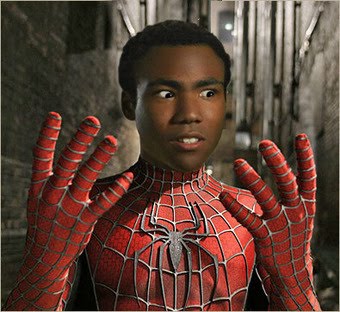
Why Can’t I Be Spider-Man?

Peter Parker is black. His experience—that of an orphaned teen from Queens who moves in with his lower-middle-class Aunt and Uncle, loses his Uncle to random violence and struggles with money/employment/love after gaining new responsibilities—is uniquely, if sadly–the violence, the substitute parenting, the poor economic condition—African-American. Despite aspects Parker’s of experience that may mark it as distinctly African-American, it is still an experience that is indicative of the American middle-class—albeit lower middle—experience; an experience that, last I checked, is unattached to any one race. Which is why the current debate over a black man’s, actor-comedian Donald Glover, ability to play the iconic Spider-Man strikes me as progressive and sad.
Over the Memorial Day weekend, Glover,
The fact that io9 even raised this question makes my heart glad. As a young comics reader, I always favored Spidey because there was no cowl or spit curl stopping me from thinking he could be black. Sure, I knew Peter Parker was white, but I also indulged the fantasy that a brother could easily be behind the bug eyes. Reading speculation of an African-American Spidey is simply cool. I’m so pleased to see that the world has grown tolerant enough to hear and debate this notion. However, I’m not naïve enough to believe this will be a reality, even in a world where Spidey makes deals with the devil and the first Captain
Neither Sony nor Disney nor Marvel would risk significantly altering their most bankable property, even if the best man for the job was black, brown or yellow. Donald Glover will not win this role because he is ill suited for the role in any logical way, but because he is not bankable to a mainstream audience. The next Spider-Man movie will not be anchored by a black lead for fear, however illogical, of it being viewed as a “urban” film. The realities of the film industry—of which there is one undeniable truth: what sells, rules—revolve around selling art as a product. If an African-American Peter Parker won’t sell to most audiences then the studios won’t entertain the notion. But, I don’t believe modern audiences would shun a Spider-Man of a different skin color. At least I hope they wouldn’t.
There are myriad reasons why audiences wouldn’t deny an African-American Peter Parker, especially in Glover’s case. Beyond the lively quality a lithe comedian like Glover might bring to the part—including the return of the sorely missed wisecracking—an African-American Spider-Man/Peter Parker will see a subtle ratcheting of the pathos due to the inherent social conditions facing lower-middle class African-Americans, adding even more gravitas to Parker's plight, and a lead that reflects the diversity of 21st century America, particularly that of contemporary New York, the "crossroads of the world." Most importantly, this refreshing take on Peter Parker/Spider-Man has the potential to transcend typical portrayals of African-Americans and their experience. In the past twenty years, how often have audiences seen a male African-American character who isn’t a criminal or a ne’er do well outside of a John Singleton, Spike Lee or Will Smith, Martin Lawrence or Tyler Perry movie? An African-American Spider-Man could prove that our men—those who aren’t Will Smith—could be heroes again. Audiences who voted for the first African-American President would be hard pressed to turn away from a movie that shows African-Americans in a better light. In an age where our images are tarnished by poverty, indignity and thuggish buffoonery, an African-American Spider-Man may not move mountains but it will surely knock a ton of rocks out of place.
Sadly, this may never come to pass, and, if it does, it will be a long ways down the road. But, more unlikely things have happened (looking at you Mr. Obama). And if the unlikely were to occur, it would be fraught with an ungodly level of resistance—racist, traditionalist and irrational—as evident in a fair amount of the early reactions to Glover’s campaign (a fact our President knows about first-hand). Much as I’d love to see an African-American Peter Parker/Spidey, I’ve resigned myself to knowing I will likely never see it happen. But, I also thought I’d never see an African-American president. So, I ask: In a world where it’s viable for one African-American to be elected president, why can’t one be Spider-Man?
Wednesday, May 12, 2010
Kicking The Iron Man's Ass - Humanity in Kick-Ass and Iron Man 2

Half an hour into Iron Man 2, I checked my cell phone clock, slouched in my seat, and leaned on the arm rest. Iron Man 2 blew into theaters last Friday, with the requisite mixed critical reaction and fanboy fervor, and it was easily the most tedious superhero flick I’ve seen in a while.
I’ll admit I never cared for Iron Man/Tony Stark and his “struggles” as the smartest, richest man in the Marvel-verse—in fact, I actively despised the clown after he inadvertently precipitated Captain America’s “death” —and cared little for the corporate intrigue of the first film. Yet, I enjoyed Robert Downey Jr.’s performance as Tony Stark, mostly because of the sheer force of his personality. Once I saw the commercials for the sequel, I expected more of the same: a great performance by Downey and a middling story of corporate espionage peppered with mecha battles. I was right. Iron Man 2 dropped below my expectations with pitiful pacing, dues ex machine plot and action figures for characters. Tony Stark, Natasha Romanov (Black Widow), Ivan Vanko (“Whiplash”) and Justin Hammer weren’t real characters; they were toys.
A week before Iron Man 2 was released, I had the pleasure of catching a film that actually treated comic book characters like human beings: Kick Ass. Kick Ass, distributed in comic form by Marvel’s creator-owned imprint, Icon, was a fun, memorable flick that put people before and “super” heroes. In Kick Ass, the story of normal people who pursue super heroics in the “real” world, each character had a life before heroism, or vigilantism as the case maybe. Whether it was Dave Liezewski’s (Kick Ass) mundane existence as a teenage nobody or Mindy McCready’s (Hit Girl) all-to-brief childhood, I believed these characters had a life—one I could relate to--beyond their absurd exploits. These characters also had clear goals. Big Daddy’s quest for revenge and Dave Liezewski’s grab at gallantry may be obsessive and misguided, but at least they were more realistic than Tony Stark being stingy with his super armor. Admittedly, both flicks strain plausibility, but the characters of Kick Ass ground the film in a semblance of reality that encourages the audience to care and cheer for the characters despite their suicidal stupidity. In Iron Man 2(IM2), the audience is told to love the super kewl characters because of their hipper-than-thou dialogue and feats of computer generated derring-do.
A comparison the of Kick Ass and IM2’s characters shows just how crucial grounded, relatable characters are to the effectiveness of films that demand suspension of disbelief. Kick Ass protagonist Dave Liezewski becomes "super" hero Kick Ass for reasons both selfish and altruistic. As much as Dave’s interest in being a superhero is bolstered by his desire for girls and popularity, he also genuinely wants to protect people, even at risk to his own safety. Tony Stark became an amplified version of this character type in the first Iron Man, as he gradually evolved form an arrogant hot shot to a hero who wanted to protect the world and erase his sins. But, in IM2, Stark regressed to the being a petulant prick due to an inability to cope with internal and external challenges. All of Stark’s character growth in IM1 is nullified by his actions in IM2. Stark is more interested in protecting his precious suit from antagonists that may never exist in the really real world than protecting the helpless from real-life terrorists. Conversely, by the end of Kick Ass, Dave Liezewski has moved from being teen with a power fantasy to honest-to-God hero when he helps Hit-Girl get her revenge on the D’Amico mob. Adding to Dave’s human-centered heroism is his resolve after being brutally injured. He doesn’t magically invent an element to save his life; he lies in the hospital, heals and returns to crime-fighting once he’s healthy. Kick Ass’ return to the streets may be based on delusional obsession, but positively rebounding from injury after a long recuperation is all-too-human.
Kick Ass’ humanity is echoed in the exploits of Big Daddy and Hit Girl. Big Daddy and Hit Girl are the opposite of IM2’s Ivan Vanko and Natasha Romanov. Big Daddy, like Vanko, is man trying violently and decisively avenge himself and his family. Both characters want to make powerful men suffer, but where their stories differ is the quality of the motivating offense and their physical response. Ivan Vanko builds a exoskeleton with electric whips to show the world “he can do what Stark can do better.” Big Daddy builds his body and gun collection while turning his daughter into a weapon in an effort to kill the man who sent him to prison and “killed” his wife. While both responses are ridiculously disproportionate, Big Daddy doesn’t care about embarrassing his opponent; he wants the guy dead. Vanko wants to shame Stark, with Stark’s death being a bonus. Both characters build “arsenals,” but Big Daddy treats himself and his daughter as the ultimate weapons as opposed to Vanko’s Gundams. Vanko balances equations and tinkers with toy robots before fighting Iron Man in a suit, that will surely protect him from nuclear attack. With little more than a bullet proof vest and some sturdy leather, Big Daddy and sidekick/daughter Hit Girl put their own bodies on the line to attack their enemies, a fact particularly evident in any scene featuring Hit Girl.
Compared to Natasha Romanov, her closest analogue in IM2, Hit Girl is a paragon of human heroism. Trained in the “art of death” by her father, Hit Girl is efficient and ruthless, yet charming and exuberant. She may move, bouncing around like a ninja slash the bad guys—in a far more effective and less-showy manner than the hipper-than-thou Romanov—but, on her off-hours, she’s a kid who loves her Dad and her toys. Hit Girl’s father may be certifiable and her toys—guns, knives and jetpacks—are surely dangerous, but its her genuine glee and warmth that reminds the audience—especially when she’s being beaten by a man three time her size—that this a “real” 11-year old child. Natasha Romanov, on the other hand, is a fembot. There’s no humanity behind her eyes, no life to her story. She’s a fully-poseable cheesecake maquette doing tricks that pale in comparison to Hit Girl’s more efficient, practical carnage. In IM2, Natasha is given one clumsy scene to demonstrate her “skill” and make the audience like her. In Kick Ass, the audience falls in love with Hit Girl because see her story and watch her drop every thug in a room more than once.
Rounding out the main characters of both films are antagonists that toe the line between friend and foe. Kick Ass’ Chris D’Amico (Red Mist) and IM2’s Justin Hammer both enter their respective films as ineffective jokes. Through betrayal and subterfuge, , they morph into dangerous villains as the films progress. The difference between these two villains is the nature of their threats, particularly in relation to the loss of human life. While Hammer is satisfied with stealing government contracts and Iron Man suit from stark, Chris takes part in a betrayal that truly threatens the lives of Kick Ass, Hit Girl and Big Daddy. By putting human life in the crossfire, rather than contracts and magic suits of armor, Kick Ass demonstrates that it deals in absolute, far from the vagaries of IM2. The villain’s response to the unveiling and, subsequent, foiling of their schemes highlights this principle. Chris is shocked, hurt and betrayed when his father threatens the heroes, and, later, is so angered by the death of his father that he sets forth on a path towards bloody vengeance. Justin Hammer, on the other hand smirks when he gets caught for allowing Vanko to turn his military robots into Iron Man-hunters. He even quietly went to jail rather than disappearing. Judging by the endings of both films, one could anticipate that in future sequels Justin hammer will return to take Tony Stark’s company while the Red Mist will return to take Kick Ass’ life. Those assumptions are indicative of the fundamental divergence between these two films: the weight of the human element.
The human element--prevalent in Kick Ass, yet lacking in IM2--grounds the fantastic in reasonable reality, encourages audience investment through character development and raises the stakes by putting lives, not companies or magic armor, in danger. The more attention a film pays to character the less likely it is to require contrived stakes. IM2 deals solely in contrived, inhuman stakes. None of the characters are ever in any real danger, so nothing matters, save plot progression. And, that’s what Marvel cares about: the mighty march to the Avengers epic. The characters in IM2 don’t serve an engaging story that delves into their core and examines the motivation and consequence of their actions; they serve a plot that teases the Avengers. Until Marvel executes its event film, and puts character first, creator-owned comic book movies will—much like their printed counterparts—capture audiences by telling stories about characters worth caring for.
Tuesday, June 30, 2009
Movie Review - Push

That was kind of fun. I wish more superhero movies were like Push. Push may not have the pedigree or prestige of Dark Knight, Iron Man, or Spiderman 2, but it was a cool, low-key alternative to those weighty, loud, effects-laden tentpoles. Sure, the material is derivative (made obvious the abundance of comic book style projects today), but the gritty, uncompromising, anti-heroic spin makes Push unique in its own way.
Dir. Paul McGuigan uses Hong Kong as an electric backdrop to this story about people born with psychic abilities and the mysterious government agency, The Division, that chases them. Chris Evans, of Human Torch fame, plays Nick Gant a ‘mover’ who moves things with his mind. Nick escaped from Division’s clutches, specifically master ‘pusher’ (telepaths who manipulate thoughts) Henry Carver (Djimon Honsou), ten years ago. Now trying to lay low in Hong Kong, Nick is pulled into a convoluted web of action by teenaged ‘watcher’ (clairvoyants who see the future) Cassie, played by a quickly maturing Dakota Fanning. The twisty plot involves Nick’s ex-girlfriend Kira (Camilla Belle), another master ‘pusher’ who escaped from division with a syringe that could boost their powers and create the typical army of super soldiers. As Nick Cassie and Kira try to evade Division and a strange gang of Asian mindbenders, they encounter an eclectic cast of psychics who may or may not be on their side.
Push gets credit for being intense and, for the most part, focused. The intensity only fades near the climax when the plot loses its way thanks to an unnecessarily convoluted and meandering escape plot. Aside from that misstep, Push succeeds on the strength of McGuigan’s vision and the understated performances by the strong cast. McGuigan uses the busy, cluttered, neon streets of Hong Kong to give Push a tough, urban feel that is more in line with Nolan’s Dark Knight than Raimi’s Spider-Man. I appreciate films like Push that, despite their subject matter, use their settings to establish a believable world. Adding to relative believability is McGuigan’s approach to power displays. The powers in Push are subtle and nowhere near as flashy as something you’d see in X-Men. CGI was thankfully kept to a minimum and it works. The subtle, deceptive or defensive ways the characters use their powers meshes perfectly with the setting and McGuigan’s visuals.
Evans and Fanning carry this movie, despite being saddled with seemingly one-note (one dimensional) characters. Honsou and Belle also turn in satisfactory performances, but their characters are too clichéd to allow for any unique displays of character. The supporting cast, including Maggie Siff, Ming-Na, and Cliff Curtis, provides a blend of eclectic allies and enemies whose cool powers mostly overwhelm their character development. Evans and Fanning both turn in understated performances with more personality than any of the characters in Heroes. Evan’s Nick is a likeable toned down version of Human Torch whose quick wit and aloofness endears more than it than grates. Fanning’s Cassie is the same streetwise teen we’ve seen before, but Fanning performs with the grace of a seasoned performer and makes the character more likeable than it deserves. The characters in Push may be forced into one-dimensionality by the overwhelming plot, which includes a heavy back-story, and about five characters too many for its two-hour runtime, but what little personality they do have shines through phenomenally. The fact that script allows these characters to talk like smartass punks they should be doesn’t hurt either. As opposed to the super-serious self-effacing characters of most superhero yarns, the characters in Push are outlaw opportunists who’d rather use their powers for personal gain than to save the world. And, really, if you had powers like these, which lend themselves more to scamming (i.e. change plain paper into money) than super powered slugfests, wouldn’t you?
Push may not be the most original story, but, thanks to McGuigan’s cool visual style and strong performances, it’s a fun twist on the X-Men/Heroes/4400 template that’s worth a look to any fan of superhero flicks.
Tankobons and Trade-waiting
Okay, maybe that’s too absolute. However, I am one of the faithful converted. I am a trade-waiter. My appreciation for monthly pamphlets is waning. After twenty years as faithful, though inconsistent, collector of monthly comics, I am beginning to collect more manga tankobons (graphic novel collections of weekly or monthly manga) and wait for trade collections of comic story arcs. Admittedly, I wanted the cliched “more bang for my buck,” but my decision is as much the result of personal choice as market phenomenon. Here’s my reasons for the switch:
1. Cost-The country’s in a recession and inevitably luxuries get cut first. I’ve always been a thrifty comic shopper, keeping my average monthly comic expense between $20-$25. It’s not bad, but the price of comics is climbing. Two weeks ago, I paid $3.99 for a 22 page comic, and I’m young enough to remember when 22 pages only cost you a buck-fifty. If all the comics I purchased on a monthly basis were $3.99, my monthly expense would creep closer to $50. Conversely, I can trade-wait or purchase manga for between $8-$15. For that amount of money I’ll get six months (six weeks in manga), on average, worth of story as opposed to five minutes of story from a $4 pamphlet. The major publishers could make monthly comics more attractive to us new media users by offering itunes-style downloads for about $.99 (Marvel has already started digital distribution, but most of the newest issues are only availble in print copies.)
2. Content- As an artist and writer who has written an unpublished graphic novel, I appreciate the work that goes into a monthly comic. If only was complete enough to hold my attention for my than five minutes. In the age of writing for trade (structuring comic story arcs for collection in a trade paperback), a monthly comic is only equal to about, on average, 1/6th of a story. Remember when you used to get a complete story every month, I do. I didn’t have a problem trade-wait style story arcs, also known as decompression, until Marvel’s House of M miniseries (awesome art, meh story.) The pacing was plodding and the delays were even worse. By the end of the series, there were roughly two month shipping gaps between issues. The shipping gaps highlighted the pacing problems. One thing I appreciate about manga tankobons is the amount of content in one volume. Most tankobons are about 200 pages, and easily collect a good chunk of the major story. Depending on the series, reading one tankobon is more of an accomplishment than reading a collected story arc from a monthly.