Showing posts with label Spider-Man. Show all posts

Friday, November 9, 2012

SPOILERS: Reboot, Soft Reboot: How Skyfall and James Bond do reboots right


"Ah, Britannia, never change...or should you?"
This shouldn't be news, but the Bond franchise has been doing reboots right for 50 years. The travesty is that most movie studios don't adhere to their basic "monkey see, monkey-do" nature and follow the lead of one of the most successful film franchises in history. With billions in box office receipts, the Bond franchise is clearly doing something right in maintaining its franchise. Meanwhile, the studios, particularly those in charge of comic properties like Spider-Man and Superman, are rebooting franchises to diminishing returns (adjusted for inflation, yes, but still diminishing).

With Skyfall, the Bond franchise nearly perfects the soft reboot. Rather than reinventing the wheel from scratch and tossing it at audiences, Skyfall organically, thoughtfully introduces a new era to the Bond franchise while honoring the staid legacy of the series. Without revealing too much, the denouement of Skyfall reinvigorates Bond's supporting cast and gives the Crown's top agent renewed focus as he darts forth into an age of espionage that is far muddier than it has ever been. Skyfall effectively and ably does for the Bond franchise what Amazing Spider-Man and Superman Returns should have done for their respective franchises. It makes the old new again without sacrificing the craft in its storytelling, much of which is due to Sam Mendes' able direction and a plot that is, thankfully, less byzantine than Quantum of Solace.

Interestingly, Skyfall apes the structure of the sequel to one of the most successful reboots in years, Nolan's The Dark Knight--confirmed explicitly by director Sam Mendes--to create an entry that is  highly effective as a point of entry for new and old audiences alike. Skyfall succeeds as much because of its easy-to-follow plot as the amazing villian at its core. Bond 23 is built around Javier Bardem's Silva, who is every inch the anti-Bond, and his vendetta against M, a point that was broached with 006 in Goldeneye. Silva is effete and desperately opposed to physical activity, yet he is cunning and seemingly ten steps ahead of Bond, M (the ever reliable Judi Dench), the audience, and much like Heath Ledger's Joker, the plot. Just as the Joker was a walking plot monkey wrench that sent the franchise into the stratosphere, Silva is one of the key draws in an entry that has already broke box office records around the world by sticking to the basics, both in terms of story and mythos, and easing the audience into transition rather than foisting it upon them.

Transition is a cornerstone of the Bond franchise, and it is one that has been ably managed by the Broccoli family to mostly positive effect. To date there have been six actors to play the role, and rarely, if ever, has the revolving casting door ever prevented the audience from connecting with the character. Sure, there's some occasional grumbling from the outliers when anybody who isn't Sean Connery takes the role--especially poor Daniel Craig, who was apparently too thuggish and blond to receive 00 status--but generally most of the audience rolls with the punch and accepts the Bond of the moment. Contrast the generally positive public response to the changing face of Bond with the outcry from critics and fans about the new Spider-Man/Peter Parker, Andrew Garfield. Many critics felt he was too smarky and harsh to embody Peter Parker's earnest everyman qualities, while others were convinced his aggressive geekiness would sink the franchise. It didn't, but the fact that Sony made kind of a big deal about a new Spider-Man may have had a lot to do with those responses. Conversely, nobody is complaining about the Bond franchise being derailed after Daniel Craig took the mantle. In fact, most have applauded the change in direction.  It is a testament to the Bond series, and its producers, willingness to move forward without making a ridiculous amount of hubub.  Instead, the Broccolis keep calm and carry on, as does the series. As a result, the James Bond of Casino Royale, Quantum of Solace, and Skyfall is your father's Bond, yet he is not, and few moviegoers have a problem with it.

SPOILER ALERT

Skyfall capitalizes on this ever-forward movement by installing new faces in old roles with amazing finese. Most folks know that there is a new Q this time around, but Mendes manages to introduce a new M and Moneypenny, not to mention an arch-villian, in a way that personally and profoundly connects them to Bond and the mythology of the series. Essentially, Skyfall becomes an origin story, albeit the origin of an era rather than a character, plopped right into the middle of a franchise. What's inherently brilliant about this new origin story is that it was unadvertised. There are faint clues that most smart viewers will pick up on early, but truthfully, there is very little made of the transition. It happens, and we are invested because we experience the transition rather than being told to simply accept the new status quo. There's also a reverence in Skyfall that acknowledges the past as it transitions to the future, complete with pretty on-the-nose nods like the return of the DB5 Aston Martin and a pit of komodo dragons. Yet, Mendes does not harp on this reverence the way Bryan Singer did in the undeservedly assailed Superman Returns. By nodding to continuity but not making it critical to the storytelling, Mendes embraces the loose approach to continuity that has defined the series but without making the narrative a slave to continuity.

This is a lesson that movie studios that deal with comic properties and long-running franchises are learning the hard way: respect history, but don't be enslaved by it. The other half of the lesson--the part the studios aren't quite grasping--is that reboots, or transitional entries, needn't exist outside of narrative. In fact, organically integrating soft reboots, as opposed to hard reboots that radically reorient a series, into a strong narrative, which it goes without saying should be paramount, can help ease audiences into a transition and garner a greater appreciation for the changes. With franchise filmmaking becoming Hollywood's primary focus these days, it is imperative that they become as good at executing reboots as possible, and the best way to do that is to incorporate reboots into transitional narratives that can stand independently as solid works of art while moving the mythology of a franchise forward.

Ideally, Hollywood would abandon franchise moviemaking and focus on creating original stories that move us. However, with the landscape resting under a cloud of rationalized fear, there is little chance Hollywood will wholeheartedly embrace a return to making tentpoles and potential blockbusters based on wholly original ideas anytime in the very near future. That said, it may be best to brace for the continued onslaught of reboots and franchise watering that is bound to greet us at our local cinemas by encouraging the studios to be a bit more thoughtful and artful when introducing these glorified cash grabs. Hopefully, the assured success of Skyfall will show Hollywood that it is possible to reboot without rehashing and alienating audiences, all while crafting a solid, engaging narrative that spins a good yarn while pushing a mythology ever towards the breach.

Monday, July 9, 2012

Soider-Man and the Amazing Zeitgeist


Apparently, not everyone loves their friendly neighborhood Spider-Man, at least not as he was portrayed in last weekend's box-office winner, The Amazing Spider-Man.

While by no means a perfect superhero flick, nor anywhere near as purely fun as The Avengers, The Amazing Spider-Man was an ambitious attempt to retell Spidey's origin in a way that won't make the kids' eyes roll. As a cinematic enterprise, Amazing was pretty slapdash, filled with dangling plot threads, underdeveloped characters, and an aesthetic that is a pretty blatant Nolan knock-off. That said, I still recommend it (I'd give it a B) to both comic book fans and the uninitiated because, despite it's flaws, Amazing is vaguely ambitious -- not swing for the fences ambitious, but audacious enough to upend central elements of a classic origin in service of table-setting and trend-chasing. This vague ambition that has insulted so many critics and Spidey purists but thrilled the casual audience is no different than any attempt by the Big Two comic publishers (DC and Marvel) to court readers younger than 30.

Based on the box office, Amazing was a success with that casual audience--one which is far less elusive to movie studios than comic book stores--but it seems the price of that success is a collection of disappointed fans and movie reviewers who felt that this new, hip Spidey, and his franchise-establishing origin--just doesn't measure up to Tobey Maguire's puppy dog-eyed portrayal of Peter Parker in Sam Raimi's vibrant, campy trilogy that launched a decade ago. The point of contention is likely rooted in director Marc Webb and his attempt to capture the zeitgeist of the contemporary teenage experience as well as the popularity of serial storytelling with a drawn-out mystery at the core with Amazing.

In Amazing, Webb introduces us to a "postmodern"--for lack of a more salient term--Peter Parker, one who exists in a world where geeks are gods and fewer kids are bullied because they have an aptitidue for technology and an appreciation for comic books. The Peter Parker of Amazing, played with equal parts snark and smarts by The Social Network's Andrew Garfield, recalls the disgruntled everyman of Stan Lee and Steve Ditko's early Spidey stories. He's nowhere near as passive as Tobey Maguire's  spin on the character, going so far as to stand up to bullies before he turns into Spidey. He's even more comfortable with girls--in this case, the target of his affection is the (SPOILER ALERT) doomed Gwen Stacy (played with typical pluck and wit by Emma Stone)--which brings to mind one of Parker's defining traits: his bad luck with multiple women. Now, think about that for a moment: Peter Parker is smart, reasonably handsome, decent, and kind of a ladies man. How do any of those traits translate into socially awkward geek? They don't necessarily, mostly because Peter has been whatever the era of or creator needs him to be (case in point: John Romita Sr.'s fashioning of Parker as more of a square-jawed lead tailored for romance comics than a bookish "science geek").

The sheer fact that Garfield's Peter is a bit dickish and geeky yet comfortable-ish around a lovely lady like Gwen reflects an amalgamation of multiple facets of Parker as he has been defined through the ages, all pulled together into a shape that would seem reasonably appealing to the modern "disenfranchised" teen geek. To respond to this version of Peter Parker with the disdain that some critics and comics fans have shows something of a misunderstanding of the basic nature of comics, that of constant change.In fact, such responses recall the shocked response of Channing Tatum's Jenko in this past spring's 21 Jumpstreet. Jenko could not understand how in five short years geeks, gays, and eco-emo kids rose to popularity when jocks and cheerleaders clearly should have ruled the high school roost. By that same token, some critics find it difficult to digest the very real need for Sony to make Spider-Man attractive to a new demographic by making his alter-ego less of a mopey wallflower and more aggressive, snarky, confident, petulant, and, well, contemporary. This may not jibe with more classic interpretations of Peter--I'll admit that Garfield seemed far too "cool" to be Peter Parker before reflecting on this topic--but times change, and while the core of the characters should remain, the trappings will inevitably change. 

As much as the changes to Spidey himself reflect an attempt on Webb's part to reach a younger audience, so to does Webb's, more likely Sony's, choice to craft Spidey's efficient origin into a serialized mystery. The Abrams-Lindelof Mystery Box approach--so named for Lost creator J.J. Abrams and showrunner Damon Lindelof--to storytelling is "hot" these days, and its popularity is very attractive to studios looking to build franchises rather than tell to good, complete stories. As a result, we get a flick like Amazing Spider-Man that ties Spidey's origin into a "touch of destiny" mystery that removes some of the everyman quality of Spidey's beginning. Of course, the purists and some critics rankle at this change, with good reason, but the, excised, notions that Peter Parker is genetically destined to become Spider-Man and the secrets of his parents are far more intriguing than implied by the Lee and Ditko's original tale are not new. In fact, Marvel has repeatedly broached this concept with mini series like 2006's Bullet Points, which asserts that, one way or another, Peter Parker was destined to become a super-powered hero of some sort, and the entire existence of Madam Web, a clairvoyant who guides Spider-Man towards his 'destiny' as a hero. This concept expands to other heroes as well, particularly Captain America, the perfect test subject for the super soldier program simply based on his inherent goodness and decency.  Granted, the whole "chosen one" angle is inherently hokey and terribly rote thanks to overuse and is generally a poor fit for Spider-Man's story, which has always had kind of a "it could be you" vibe, but it is nothing new. Marvel has always pushed the limit of the integrity of its original stories by allowing its creators to make strenuous connections between errant plot threads, an approach which is far from limited to Marvel (see Grant Morrison's multi-year run on Batman). 

The serialized franchise building on display in Amazing may be disheartening because it appears to be a naked attempt by Sony to retain the Spider-Man license, which it absolutely is, but it is hardly unique to the movie studios. As much as this approach disappoints some of the audience,  it is, for better or worse, the nature of comic books writ large; they must constantly reinvent themselves at the risk of losing the past generation of readers; but if we accept that some of the more popular characters are not the sole dominion of one generation and must be made relevant to the next generation of readers then we can come to place where we accept the idea and the spirit of the effort even if the execution is flawed. Amazing Spider-Man may not be the most perfectly executed version of Spidey origin, but the changes are far more indicative decades old trend of reinvention that consistently risks gaining a new audience at the expense of another. That said, the new Spidey flick may not be everybody's cup of tea, but it deserves at least .

Friday, June 4, 2010

Why Can’t I Be Spider-Man?


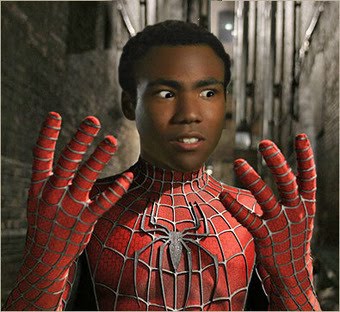
Peter Parker is black. His experience—that of an orphaned teen from Queens who moves in with his lower-middle-class Aunt and Uncle, loses his Uncle to random violence and struggles with money/employment/love after gaining new responsibilities—is uniquely, if sadly–the violence, the substitute parenting, the poor economic condition—African-American. Despite aspects Parker’s of experience that may mark it as distinctly African-American, it is still an experience that is indicative of the American middle-class—albeit lower middle—experience; an experience that, last I checked, is unattached to any one race. Which is why the current debate over a black man’s, actor-comedian Donald Glover, ability to play the iconic Spider-Man strikes me as progressive and sad.

Over the Memorial Day weekend, Glover, Troy on NBC’s Community, started a online campaign to audition for the currently vacant role of Peter Parker/Spider-Man in a Sony’s Spider-Man reboot. Glover’s campaign was a direct response to a rant on sci-fi pop culture blog io9 that stated, “the last thing Spider-Man should be is another white guy.” This statement, both timely and provocative, has met with applaud and derision. The majority of the applaud came from fans who see Spider-Man as a character beyond color: an everyman who speaks to the struggle of growing up and facing responsibility; while detractors take the stance that Spider-Man was designed as white character and should remain thus to ensure a faithful adaptation.


The fact that io9 even raised this question makes my heart glad. As a young comics reader, I always favored Spidey because there was no cowl or spit curl stopping me from thinking he could be black. Sure, I knew Peter Parker was white, but I also indulged the fantasy that a brother could easily be behind the bug eyes. Reading speculation of an African-American Spidey is simply cool. I’m so pleased to see that the world has grown tolerant enough to hear and debate this notion. However, I’m not naïve enough to believe this will be a reality, even in a world where Spidey makes deals with the devil and the first Captain America was black.


Neither Sony nor Disney nor Marvel would risk significantly altering their most bankable property, even if the best man for the job was black, brown or yellow. Donald Glover will not win this role because he is ill suited for the role in any logical way, but because he is not bankable to a mainstream audience. The next Spider-Man movie will not be anchored by a black lead for fear, however illogical, of it being viewed as a “urban” film. The realities of the film industry—of which there is one undeniable truth: what sells, rules—revolve around selling art as a product. If an African-American Peter Parker won’t sell to most audiences then the studios won’t entertain the notion. But, I don’t believe modern audiences would shun a Spider-Man of a different skin color. At least I hope they wouldn’t.


There are myriad reasons why audiences wouldn’t deny an African-American Peter Parker, especially in Glover’s case. Beyond the lively quality a lithe comedian like Glover might bring to the part—including the return of the sorely missed wisecracking—an African-American Spider-Man/Peter Parker will see a subtle ratcheting of the pathos due to the inherent social conditions facing lower-middle class African-Americans, adding even more gravitas to Parker's plight, and a lead that reflects the diversity of 21st century America, particularly that of contemporary New York, the "crossroads of the world." Most importantly, this refreshing take on Peter Parker/Spider-Man has the potential to transcend typical portrayals of African-Americans and their experience. In the past twenty years, how often have audiences seen a male African-American character who isn’t a criminal or a ne’er do well outside of a John Singleton, Spike Lee or Will Smith, Martin Lawrence or Tyler Perry movie? An African-American Spider-Man could prove that our men—those who aren’t Will Smith—could be heroes again. Audiences who voted for the first African-American President would be hard pressed to turn away from a movie that shows African-Americans in a better light. In an age where our images are tarnished by poverty, indignity and thuggish buffoonery, an African-American Spider-Man may not move mountains but it will surely knock a ton of rocks out of place.


Sadly, this may never come to pass, and, if it does, it will be a long ways down the road. But, more unlikely things have happened (looking at you Mr. Obama). And if the unlikely were to occur, it would be fraught with an ungodly level of resistance—racist, traditionalist and irrational—as evident in a fair amount of the early reactions to Glover’s campaign (a fact our President knows about first-hand). Much as I’d love to see an African-American Peter Parker/Spidey, I’ve resigned myself to knowing I will likely never see it happen. But, I also thought I’d never see an African-American president. So, I ask: In a world where it’s viable for one African-American to be elected president, why can’t one be Spider-Man?